
Builder Rate Buydown vs. Price Reduction in Utah: Which Is Actually Better?
Quick Answer: In most cases the rate buydown wins, and it usually wins faster than people expect. On a real Utah new construction deal, a builder charged $20,000 more for the home in exchange for a permanent rate buydown — and the buyer recovered that $20,000 in about three years and eight months on the fixed-rate option, or two years on the ARM. The reason is that builders subsidize buydowns well beyond what they add to the price.
Almost nobody publishes an actual number on this. Here is one, with the math shown.
Should You Take the Builder’s Rate Buydown or the Price Reduction?
Start with the instinct most buyers have, because it is wrong in a specific and expensive way.
A price reduction feels like the safer, more honest option. It is a real number coming off a real price. A rate buydown feels like financial engineering — something the builder is doing for reasons of their own.
The builder is doing it for reasons of their own. A recorded price cut lowers the comparable sales for every other home in that community. A financing incentive does not. But that motive does not make the incentive worth less to you. It usually makes it worth more, because it lets the builder be more generous than they could be on price.
A Real Utah Example, With the Numbers
This is an actual Utah new construction deal from mid-2026. The builder gave the buyer a straight choice.
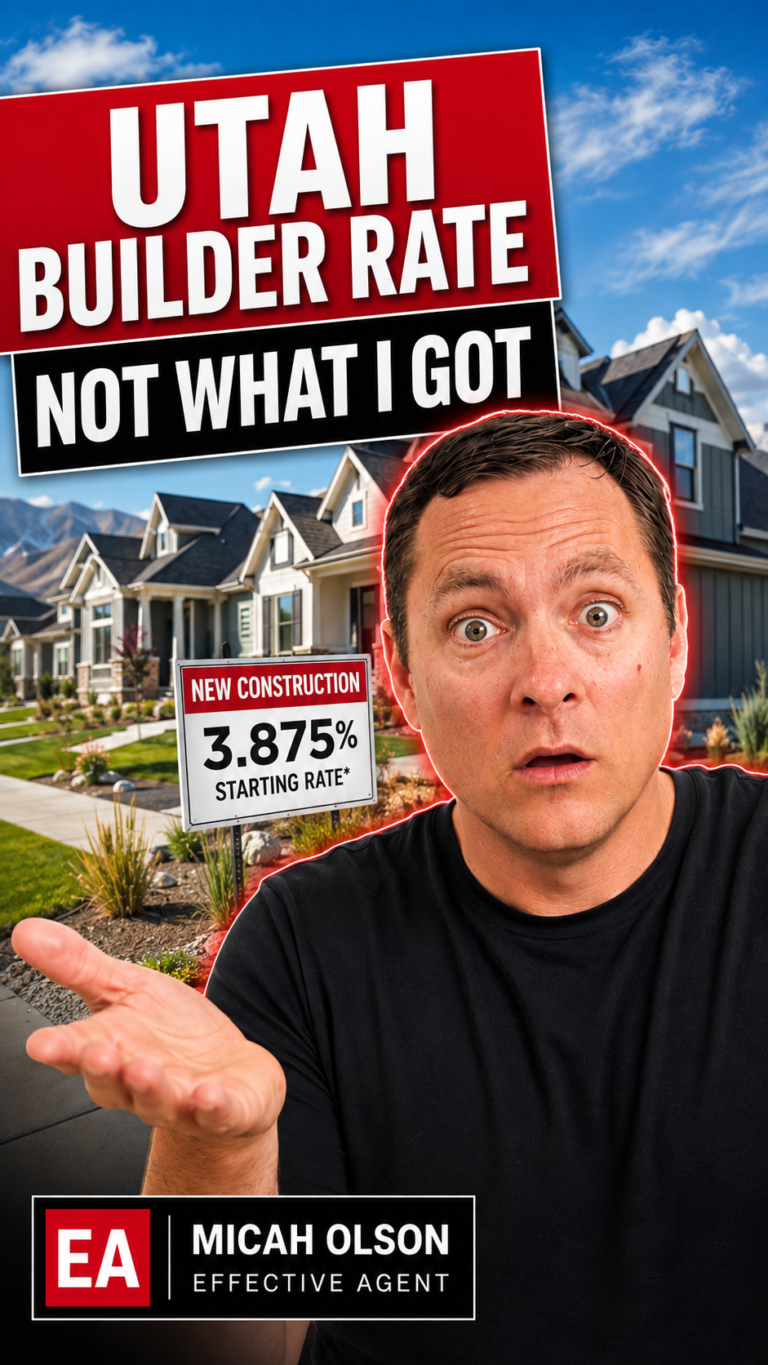
Without the buydown, the home was $707,000. With the buydown, it was $727,000 — twenty thousand dollars more. In exchange, the buyer could take either a 4.99% 30-year fixed or a 3.875% 7/6 ARM. Market rates at the time were slightly over 6.5%. Twenty percent down either way.
| Option | Loan amount | Rate | Monthly P&I | Monthly savings |
|---|---|---|---|---|
| No buydown, market rate | $565,600 | 6.50% | $3,575 | — |
| Buydown, 30-year fixed | $581,600 | 4.99% | $3,119 | $456 |
| Buydown, 7/6 ARM | $581,600 | 3.875% | $2,735 | $840 |
Breakeven on the $20,000: about three years and eight months on the fixed, about two years on the ARM.
Property taxes on the extra $20,000 of value add roughly ten dollars a month, which moves those numbers by about a month. Not enough to change the decision.
Why the Buydown Wins by So Much
Here is the part that explains everything, and I have never seen a builder spell it out.
That $20,000 bought a 1.51 percentage point reduction in rate on a $581,600 loan. If you walked into a lender and asked to buy your rate down that far with your own money, you would generally be looking at something closer to six points — roughly $35,000 to $45,000.
So the builder added $20,000 to the price and delivered something worth closer to $40,000. They are subsidizing the buydown well beyond what they charged for it.
That is why comparing the headline numbers gets buyers to the wrong answer. Twenty thousand off the price is twenty thousand of value. Twenty thousand spent on a builder-subsidized buydown is frequently double that. They are not equivalent offers wearing different hats.
How Long Do You Have to Stay for It to Pay Off?
Shorter than most people assume. In the example above, under four years on the fixed and about two on the ARM.
Set against that, the median homeowner stays put considerably longer than four years. So for a typical buyer relocating to Utah County or Salt Lake County and settling in, the buydown is not a close call — it clears breakeven well before they are likely to move, and every month after that is pure savings.
Held through the ARM’s full seven-year fixed period, that $840 a month adds up to roughly $70,600 against a $20,000 cost.
When Does the Price Reduction Actually Win?
There are real cases, and they all come down to the same thing: the buydown only pays you back through monthly payments, so anything that shrinks or shortens those payments shrinks the benefit.
You are paying cash. No loan, no rate, no buydown. Take the price.
You are putting down a very large down payment. A small loan means the rate reduction is working on less money, so breakeven stretches out.
You know you are moving soon. A job with a two-year horizon, a temporary relocation, a home you already consider a stepping stone. If you will not reach breakeven, the price cut is worth more.
You are near a qualifying ceiling on the purchase price — a loan limit or a program cap, like the Utah first-time buyer new construction program with its price ceiling. Sometimes the lower price is what makes the deal possible at all.
The Short Version
- Builders prefer buydowns because they protect the recorded sale price and the community’s comps.
- That preference works in your favor — they subsidize the buydown beyond what they add to the price.
- On a real Utah deal, $20,000 bought a rate reduction worth roughly $35,000–$45,000 at retail pricing.
- Breakeven came in around three years eight months on the fixed, two years on the ARM.
- Take the price reduction if you are paying cash, putting a large amount down, leaving soon, or bumping a price cap.
- Never compare the two on headline dollars. Compare the payment and your realistic timeline.
Frequently Asked Questions
Is a builder rate buydown better than a price reduction in Utah?
Usually yes, if you plan to keep the loan more than a few years. Builders subsidize rate buydowns beyond what they add to the price, so the same nominal dollars deliver more value through the buydown. On a real Utah deal, $20,000 bought a rate reduction worth closer to $40,000.
How long does it take a rate buydown to pay for itself?
On a documented mid-2026 Utah deal it took about three years and eight months on a 30-year fixed and about two years on a 7/6 ARM. The exact figure depends on loan size and the size of the rate reduction, but it is commonly shorter than buyers expect.
Why do builders prefer buydowns over lowering the price?
A recorded price reduction lowers the comparable sales for every remaining home in the community. A financing incentive does not show up the same way. Protecting comps is worth enough to builders that they will spend more on a buydown than they would cut from the price.
When should I take the price reduction instead?
Take the price cut if you are paying cash, making a very large down payment, expect to sell within a couple of years, or need a lower purchase price to stay under a loan limit or program cap.
Does paying more for the home raise my property taxes?
Slightly. In the example above, the extra $20,000 in value added roughly ten dollars per month, which pushed breakeven out by about a month. It is real but rarely changes the decision.
Want This Run on the Offer in Front of You?
Every builder structures this differently, and the breakeven changes with loan size, down payment, and how long you actually plan to stay. If you are weighing a builder’s incentive options in Utah County or Salt Lake County and want both paths run side by side in writing, send me a message with the word INCENTIVES.
I have spent 29 years in Utah real estate and recently bought a production-built home myself, so I have made this comparison with my own money as well as for clients.
Related reading: Utah Builder Incentives — How They Work and How to Compare Them · 2-1 Buydown vs. Permanent Buydown in Utah · Do I Have to Use the Builder’s Preferred Lender?