Why a Utah Builder’s Advertised Rate Isn’t a Guarantee
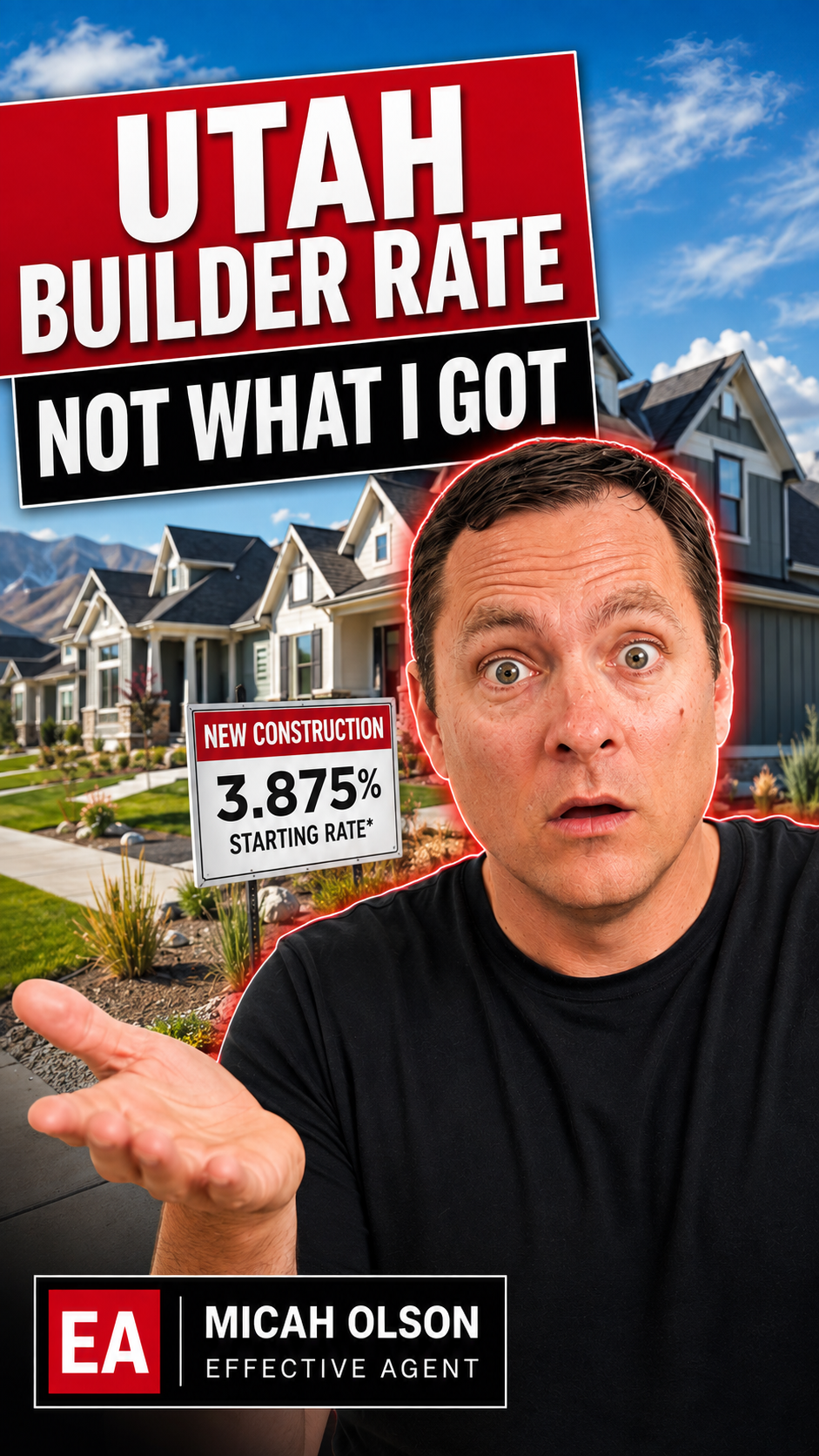
Quick Answer: No – a Utah builder’s advertised mortgage rate is typically the best-case number for its most qualified buyers, not a guarantee for everyone who walks in the door. Micah Olson saw this on his own new construction purchase: the builder advertised 3.875%, but he was underwritten at 3.99% despite credit above 720, 20%+ down, and a solid debt-to-income ratio.
If a buyer with strong credit and a large down payment doesn’t get the advertised number, it’s worth asking who actually does.
Is a Builder’s Advertised Rate Guaranteed for Every Utah Buyer?
Not automatically. The rate on a builder’s flyer, website, or Instagram ad is real – someone is closing at that number – but it’s usually tied to a specific combination of credit score, down payment, loan amount, and loan program. That combination represents the builder’s most qualified buyer, not a promise to every buyer who shows up.
This doesn’t mean the incentive is fake or a bait-and-switch. Builders and their preferred lenders advertise the rate that makes the deal look its best, the same way any lender advertises its lowest available number. The mistake is treating that number as locked in before your own file has actually been underwritten.
Once your income, credit, and loan details go through underwriting, your real rate can land above or below the advertised one – and in Utah’s current market, most buyers should expect it to land at or above it unless they specifically fit the top tier the ad was built around.
Why Builder Rate Ads Show a Best-Case Number, Not Everyone’s Number
Mortgage pricing is built in tiers. Lenders adjust the rate they can offer based on credit score bands, down payment size, loan amount, occupancy type, and the specific loan program being used. The rate a builder chooses to put in an ad is almost always the best tier their lender can produce – the number that gets attention – not an average across every buyer who applies.
That’s not unique to builder financing. Any lender’s advertised rate works the same way. What makes it worth flagging for Utah new construction buyers specifically is that the advertised rate is usually tied directly to the builder’s incentive, so it’s easy to mentally lock in that number early and build a budget around it before a lender has actually run your file.
What Happened on Micah’s Own Utah New Construction Purchase
Micah bought his own Utah new construction home from DR Horton as part of a downsizing move, and financed it through the builder’s preferred lender using a 7/6 ARM. The rate advertised for that loan was 3.875%. When his own file went through underwriting, the rate that came back was 3.99% – a quarter point higher than the number he’d been expecting.
He wasn’t a marginal buyer. Credit above 720, 20% or more down, and a debt-to-income ratio well within normal guidelines – the kind of profile most builders would call strong. The gap wasn’t a red flag on his file. It was simply that the advertised 3.875% represented the builder’s best-case pricing tier, and his actual loan scenario landed a step below it.
Micah has told this story in earlier content using the 3.875% figure as his own final rate – that was inaccurate, and 3.99% is the correct number. The advertised-versus-actual gap itself turned out to be a more useful thing to talk about than the original number ever was.
What Actually Moves Your Rate Away From the Advertised Number
A handful of ordinary factors can shift a buyer’s real rate away from a builder’s advertised one, even for a well-qualified buyer:
Credit score tier – most rate sheets step down in increments, so a buyer even a few points below the top tier the ad assumes can land on a different pricing bracket. Down payment size and loan amount – larger loans or lower down payments can carry their own pricing adjustments. Loan program specifics – the exact loan product, and whether it’s a flat-rate or stepped-rate structure, changes how it’s priced. Timing – mortgage rates move with the broader market, and an ad published last week may not reflect today’s pricing by the time your rate actually locks.
None of these are hidden fees or unusual builder tactics. They’re the same pricing mechanics behind any advertised mortgage rate – they just matter more here because the advertised number is doing double duty as both a rate and a marketing hook for the incentive.
How This Differs From a Stepped-Rate ARM Not Qualifying at Its First-Year Rate
This is a different issue from the one covered in why a stepped-rate ARM isn’t the rate you’ll qualify for in Utah, and it’s worth keeping the two separate. A stepped-rate ARM has a specific underwriting rule behind it: Utah lenders must qualify the buyer at the highest rate scheduled within the loan’s first five years, not the low first-year number, because that’s what Ability-to-Repay rules require.
The gap Micah ran into wasn’t a stepped-rate underwriting rule – his loan was a flat-rate 7/6 ARM, one number for the full seven years. The difference between 3.875% advertised and 3.99% actual came from ordinary rate-sheet pricing, not a scheduled step-up. It’s a broader issue that can touch any loan type, fixed or ARM, flat or stepped – the advertised number simply isn’t guaranteed until your specific file is priced.
How to Protect Your Budget Before You Count on the Advertised Rate
Ask the builder’s lender for a personalized rate quote early, before you’re emotionally attached to a specific home or floor plan – and ask directly what credit score, down payment, and loan program the advertised rate assumes. A lender should be able to tell you where your own file lands against that tier.
Get that quote in writing, and build your budget around your own number rather than the number in the ad. A quarter-point gap doesn’t sink most Utah new construction deals, but it’s a lot easier to plan for before you’ve picked out cabinets than after you’re already emotionally committed to the home.
The Short Version
- A builder’s advertised mortgage rate is usually its best-case number for the most qualified buyers – not a promise to every buyer.
- Micah’s own Utah new construction purchase: builder advertised 3.875%, he was underwritten at 3.99%, despite credit above 720, 20%+ down, and a solid debt-to-income ratio.
- Credit tier, down payment size, loan program, and market timing can all move a buyer’s real rate away from the advertised one.
- This is different from a stepped-rate ARM, which has its own underwriting rule requiring qualification at the highest scheduled rate – the advertised-rate gap can affect any loan type.
- Ask for a personalized, written rate quote early, and find out what tier the advertised rate assumes before you build a budget around it.
Frequently Asked Questions
Is a builder’s advertised mortgage rate the rate every buyer gets?
No. The advertised rate is usually the number a builder’s lender can offer its most qualified buyers on a specific loan scenario. Your own credit profile, loan amount, down payment, and loan program can move your actual quoted rate up or down from that number.
Why would a buyer with strong credit still get a higher rate than advertised?
An advertised rate is typically priced for a best-case combination of credit, down payment, loan program, and timing. Even a buyer who qualifies well on paper can land outside that exact combination – Micah’s own purchase, with credit above 720, 20%+ down, and a solid debt-to-income ratio, still came in at 3.99% against a builder-advertised 3.875%.
Does a builder’s advertised rate change between when you see the ad and when you close?
It can. Mortgage rates move with the broader market, and the rate quoted in marketing is typically tied to the day it was published – not the day your loan actually locks. Ask the lender to confirm today’s rate rather than assuming the number you first saw still applies.
How is this different from a stepped-rate ARM not qualifying at its first-year rate?
A stepped-rate ARM is a separate issue – Utah lenders are required to underwrite at the highest rate scheduled within the loan’s first five years, not the low starting number. That’s a specific underwriting rule for stepped ARMs. The advertised-rate gap here is broader – it can affect any loan type, flat-rate or stepped, fixed or ARM.
What should you ask the builder’s lender before writing an offer?
Ask for your own personalized rate quote, in writing, before assuming the advertised number applies to you – and ask what credit score, down payment, and loan program that advertised rate assumes. A lender should be able to tell you where your actual file lands against it.
Want the Full Breakdown on Builder Incentives?
I’ve spent 29+ years in Utah real estate, and I still ran into this gap on my own purchase – which tells you it’s worth checking no matter how strong your file looks on paper. Comment INCENTIVES, or send me a message with the word INCENTIVES, and I’ll send you the Builder Incentives Guide.