
Lender Rate vs. Builder Rate: How Much House Can You Actually Afford in Utah?
Quick Answer: Your lender’s qualifying number in Utah isn’t fixed – it’s built entirely around your monthly payment, and that payment depends on your interest rate. Finance the exact same payment through a Utah builder’s lower rate instead of your lender’s market rate, and you can qualify for a meaningfully more expensive home. One Utah buyer’s lender capped him at $550,000; the same monthly payment through a builder rate reached $758,000.
That’s not a rounding error – it’s roughly $200,000 of home for the exact same payment your lender already approved.
How Much More Home Can a Builder Rate Get You in Utah?
A lender’s pre-qualification number in Utah is really a monthly-payment number wearing a price tag. That payment is built from two variables – your interest rate and your down payment. Change either one, and the price that payment buys changes with it. Most buyers never think to question that part of the conversation.
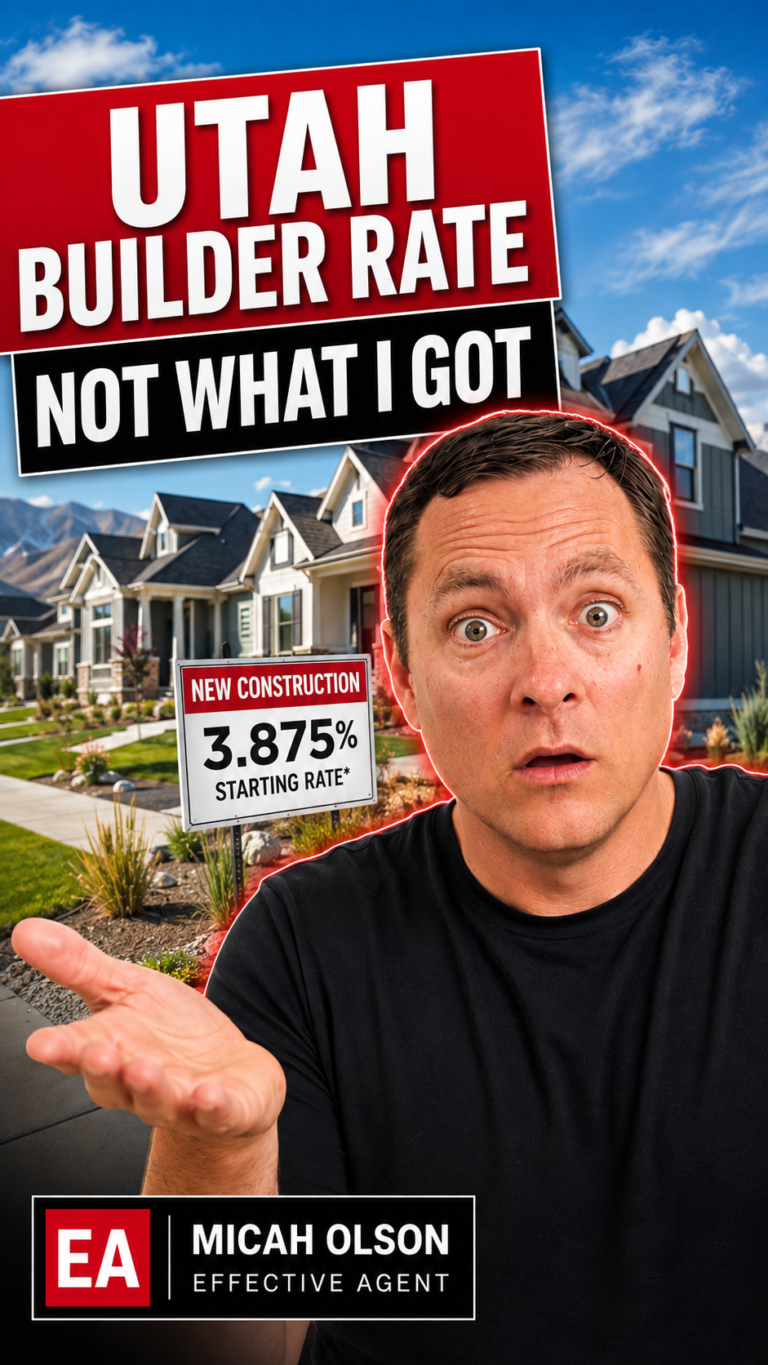
Run the actual numbers. A Utah buyer’s lender capped him at $550,000 – 3.5% down, at a rate of 6.75% – for a monthly payment right around $3,442. Take that same $3,442 and finance it through a Utah builder currently offering a rate near 3.875% instead, same down payment, and the qualifying price climbs to roughly $758,000. Same buyer, same income, same monthly payment the lender already approved. The only thing that changed is which rate financed it.
None of this means the lender did anything wrong. A bank quotes its own available rate – it isn’t going to sell a buyer on a builder’s in-house financing or a state grant program, because that isn’t its product.
What $550,000 vs. $758,000 Actually Looks Like in Lehi, Utah
The gap is easiest to see against real homes for sale in Lehi, Utah. At $550,000, a lender’s number typically buys resale – something built between 2006 and 2020, roughly 2,300 to 2,600 square feet, sometimes with an unfinished basement, and a roof, furnace, AC, and appliances anywhere from 6 to 20 years old on a modest lot. There’s nothing wrong with that home – it’s simply an older one.
Finance the identical payment through a builder rate instead, and $550,000 stops being the ceiling. The same payment reaches new construction closer to $750,000 – 3,400 to 3,800 square feet, a larger lot, quartz counters, a tankless water heater, and a home warranty on everything. Same monthly commitment, a different decade and a different set of systems.
Is the $3,442 Payment the Full Story?
Not quite, and it’s worth saying plainly: that $3,442 is principal and interest only. Add taxes and insurance and both scenarios land close to the same real monthly payment, with the pricier new-construction home running a little higher there since property taxes typically scale with purchase price. It doesn’t erase the gap – it just means the true numbers on both sides are slightly higher than the P&I figure alone.
One More Thing: Utah’s $20,000 First-Time Buyer Grant
There’s a separate lever worth asking about if you qualify. Utah Housing Corporation’s First-Time Homebuyer Assistance Program can put up to $20,000 toward a new construction home priced at or under $450,000. It’s limited to first-time buyers, slots aren’t unlimited, and terms can change – but stacked on top of a builder rate, it’s a second question worth asking rather than assuming you don’t qualify.
What to Ask Before You Assume Your Price Ceiling Is Set
Before treating a lender’s number as final, ask two more questions: what would this same payment buy financed through a builder’s rate instead of my lender’s, and do I qualify for any assistance program on new construction? Neither question costs anything to ask, and both can move the ceiling more than most buyers expect.
The Short Version
- Your lender’s qualifying number is a function of your monthly payment and your interest rate – not a fixed ceiling.
- One Utah buyer’s lender capped him at $550,000 at 6.75%; the identical $3,442/month payment through a Utah builder’s 3.875% rate qualified him for $758,000.
- At $550,000 in Lehi, Utah, that payment currently buys an older resale home – built 2006-2020, 2,300-2,600 sq ft, sometimes an unfinished basement. At $758,000, the same payment reaches new construction closer to 3,400-3,800 sq ft with a home warranty.
- The $3,442 figure is principal and interest only – taxes and insurance narrow the gap slightly.
- Utah’s First-Time Homebuyer Assistance Program can add up to $20,000 toward a new construction home under $450,000, for qualifying buyers.
- Before assuming your price ceiling is set, ask what the same payment buys through a builder rate instead of your lender’s.
Frequently Asked Questions
Why does my lender’s home-buying budget change with the interest rate?
Your lender’s number is really a monthly-payment number translated into a home price at a specific interest rate. Change the rate financing the same payment, and the qualifying price changes with it – the payment amount stayed the same, only the rate attached to it moved.
Is a builder’s rate always lower than what a bank or outside lender will quote?
Not automatically, but it’s common with new construction in Utah right now – builders subsidize their in-house or affiliated lender’s rate as part of the incentive package, which is why it can beat what an outside lender quotes on the same buyer file. Confirm the current rate directly with the builder before assuming it applies to your situation, since incentives change from community to community and month to month.
Does the $758,000 number include taxes and insurance?
No – the $3,442 monthly figure in this example is principal and interest only. Add property taxes and homeowner’s insurance and both scenarios land close to the same real payment, with the higher-priced new construction home running slightly higher there since taxes are typically based on purchase price.
Who qualifies for Utah’s $20,000 first-time buyer new construction grant?
Utah Housing Corporation’s First-Time Homebuyer Assistance Program can put up to $20,000 toward a new construction home priced at or under $450,000, for qualifying first-time buyers. Slots and eligibility details are limited and can change, so confirm current terms with your lender or with me before counting on it.
Should I always choose the builder’s rate over my own lender in Utah?
Not automatically – the practical move is to have your own lender audit the builder’s offer for hidden fees or terms, not to assume either side is always the better deal. But when a builder’s rate is genuinely lower, running the same payment through it is worth doing before you accept your outside lender’s number as your ceiling.
Want to See What Your Payment Actually Qualifies For?
I’ve spent 29+ years in Utah real estate watching buyers assume their lender’s first number is the ceiling. Comment PAYMENT, or send me a message with the word PAYMENT, and I’ll walk you through what your payment actually qualifies for in Utah new construction – builder rate and grant programs included.