The Utah $20,000 Grant and the Builder Rate: Here’s the Catch
Quick Answer: Utah’s $20,000 first-time buyer assistance for new construction only comes through a Utah Housing Corporation first mortgage. Because a Utah builder rate buydown is delivered through the builder’s own preferred lender, most first-time buyers can’t take the $20,000 grant and that advertised builder rate at the same time. Per one Utah builder’s lender, the usual substitute is a price cut or closing-cost credit stacked on top of the $20,000 instead.
Builders will happily tell you about the $20,000. The part that tends to go unsaid is what it does to the rate on the sign out front.
Does the Utah $20,000 Grant Cost You the Builder Rate?
Usually it changes what “the incentive” means for you. Utah’s S.B. 240 first-time buyer program – most people call it the $20,000 grant, though it’s structured as a $20,000 second loan with no monthly payment and no interest until you sell or refinance – can be used on a newly built Utah home priced at or below $450,000. But the money only comes through a Utah Housing Corporation first mortgage, originated by a participating lender.
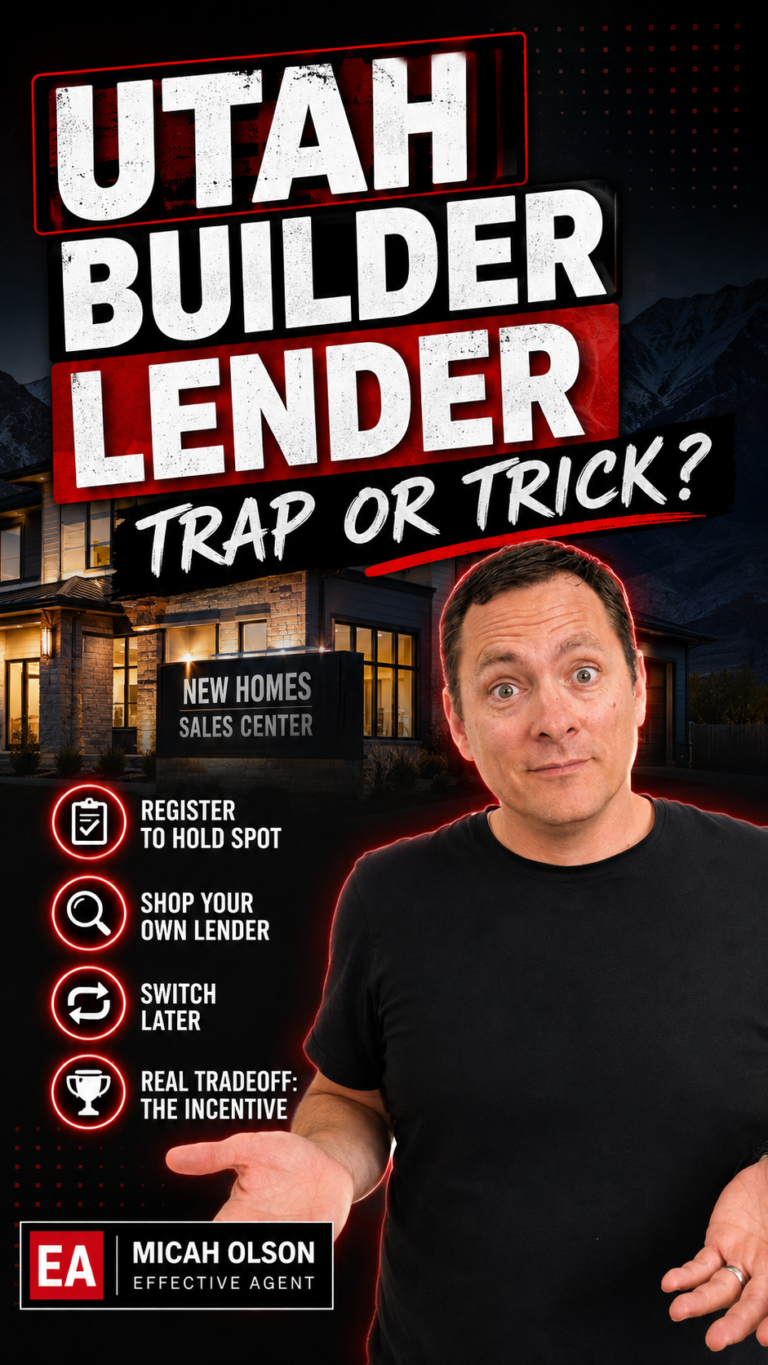
That requirement is the whole catch. When a Utah builder advertises a rate – the low three-point-something number on the flyer – that rate runs through the builder’s preferred lender, who is using builder incentive dollars to buy it down on their own loan. Utah Housing Corporation sets its own rates on its own mortgage, and the builder’s lender has no way to buy down a loan they aren’t originating.
So a first-time buyer who wants the $20,000 is generally choosing a Utah Housing loan at Utah Housing’s rate – not the builder’s loan at the builder’s advertised rate. According to one Utah builder’s lender who walked through this with us, the workaround, depending on the specific home, is often a straight price reduction or a seller-paid closing-cost credit offered on top of the $20,000, in place of the advertised rate buydown.
Why Can’t the Builder Just Buy Down the Utah Housing Rate?
Because it isn’t their loan. A builder’s rate incentive is a pricing tool on the preferred lender’s product – the lender discounts the rate, the builder covers the cost out of its incentive budget. Utah Housing Corporation is a separate entity with its own mortgage, its own rate sheet, and its own rules about what assistance layers on top. The builder’s lender simply has no mechanism to discount a mortgage they don’t originate.
This isn’t a builder doing something underhanded. It’s two programs that were never designed to stack. The friction is that the sales conversation usually presents the $20,000 and the advertised rate as though you get both, and a lot of buyers don’t learn otherwise until they’re well into the loan application on a house they’ve already picked out.
How Do You Figure Out Which One Is Worth More in Utah?
Run them as two separate scenarios with real numbers – not the advertised rate against a guess:
- Scenario A: builder’s preferred lender, builder’s advertised rate and incentive, no $20,000.
- Scenario B: Utah Housing loan at Utah Housing’s rate, plus the $20,000 applied to down payment or a permanent buydown on that loan, plus whatever price cut or closing-cost credit the builder will give in place of the rate incentive.
Then compare the actual monthly payment and the total cash to close on each. On a lower-priced Utah home near the $450,000 cap, the $20,000 plus a price concession often wins, because $20,000 is a large share of that loan. On a home closer to the top of a first-time buyer’s range, a deep builder rate buydown can pull ahead over time. There is no universal answer – it’s a math problem specific to the home, the loan program, and the day’s rates.
What to Ask Before You Get Attached to a House
Ask the builder’s lender directly: if I use the Utah $20,000 assistance, what happens to this advertised rate, and what will the builder give me instead? Ask whether the home is actually under $450,000 and otherwise eligible. Ask whether you meet the first-time buyer definition – generally no homeownership in the past three years, plus a Utah residency requirement – and confirm the program still has funding, since it’s capped and first-come. Get both scenarios in writing before a specific floor plan talks you into a decision.
The Short Version
- Utah’s $20,000 first-time buyer assistance requires a Utah Housing Corporation first mortgage – it’s a $20,000 no-payment second loan, repaid when you sell or refinance, on homes priced at or below $450,000.
- A builder’s advertised rate buydown runs through the builder’s preferred lender, so it generally can’t be combined with the $20,000.
- Per one Utah builder’s lender, the common substitute is a price cut or closing-cost credit on top of the $20,000, instead of the advertised rate.
- Which is worth more depends on the home’s price and current rates – compare the real payment and cash-to-close on each, in writing.
- The program is capped and first-come; confirm current funding and eligibility with Utah Housing Corporation or a participating lender.
Frequently Asked Questions
Do you have to use Utah Housing Corporation as your lender to get the $20,000?
Yes. The S.B. 240 first-time buyer assistance is only available through a Utah Housing Corporation first mortgage, originated by a participating lender. If you finance the home any other way, you can’t access the $20,000.
Is the Utah $20,000 first-time buyer assistance actually a grant?
Not exactly. It’s commonly called a grant, but it’s structured as a $20,000 loan with no monthly payment and no interest. It’s repaid when you sell or refinance – the lesser of the amount you received or 50% of your home’s equity at that time.
Can the $20,000 be used to buy down my mortgage rate?
Yes, but on the Utah Housing loan, not the builder’s loan. The assistance can go toward down payment, closing costs, or a permanent rate buydown on the Utah Housing first mortgage. It can’t be used to buy down the builder’s preferred-lender rate.
What does the builder give me instead of the advertised rate if I take the grant?
According to one Utah builder’s lender, it’s often a price reduction or a seller-paid closing-cost credit, offered in addition to the $20,000. This varies by builder and by the specific home, so ask each builder’s lender how they handle it before you count on anything.
Which is the better deal – the $20,000 or the builder’s rate incentive?
It depends on the home’s price and current rates. On a lower-priced home, $20,000 is a big share of the loan and usually wins. On a home near the top of your budget, a deep builder rate buydown can save more over the years. Compare both as full payment-and-cash-to-close scenarios before deciding.
Does every Utah builder have homes that qualify for the $20,000?
No. The home has to be new construction, never lived in, and priced at or below $450,000. Many Utah builders have some qualifying inventory, but not every community or floor plan fits under the cap.
Talk Through Your Options Before You Pick a House
I’ve spent 29+ years in Utah real estate, and this is one of the most common places first-time buyers get surprised late in the process. Comment BUILDER, or send me a message with the word BUILDER, and I’ll send you my free Utah new construction buyer checklist.