
New Construction Homes Utah: What Buyers Need to Know Before They Sign Anything
New construction homes are getting a lot of attention in Utah right now — and for legitimate reasons. Builder rate incentives, modern floor plans, energy efficiency, and the ability to avoid bidding wars on resale inventory have made new construction an attractive option for relocating families and local move-up buyers alike.
But attractive is not the same as right for everyone. And “the builder’s rep was really helpful” is not the same as having someone in your corner who actually understands the contract you are about to sign.
This guide covers what Utah buyers genuinely need to understand about new construction — the financial mechanics, the contract realities, the things builders do not always explain clearly, and how to decide whether new construction or resale makes more sense for your specific situation. It is written for buyers who want to think clearly before they commit, not for buyers looking for permission to get excited.
Why New Construction Is Worth Serious Consideration in Utah Right Now
The Market Problem New Construction Helps Solve
The Utah resale market has a well-documented inventory problem. Homeowners who purchased or refinanced at historically low interest rates in 2020 and 2021 have little financial incentive to sell — which means the supply of existing homes for sale has stayed constrained even as buyer demand remains active.
New construction fills that gap. Builders are actively producing inventory across Utah County and Salt Lake County, which means buyers who focus only on resale are competing in a tighter pool while an entirely separate market of new homes sits available — often with financial incentives attached.
That does not make new construction automatically the right choice. But it does make it worth a serious, eyes-open look before you decide.
What Makes New Construction Genuinely Different From Resale
The home is new. That sounds obvious, but the practical implications matter. No deferred maintenance from the previous owner. No aging roof, HVAC, water heater, or electrical panel to worry about on day one. Modern energy codes mean tighter insulation, better windows, and lower utility costs compared to older homes. Builder warranties — typically one year on workmanship, two years on mechanical systems, and ten years on structural defects — provide a layer of protection resale homes do not offer.
The financial structure is different. Builders control the financing environment in a way sellers of resale homes cannot. Through partnerships with preferred lenders, builders can offer interest rate buydowns, closing cost contributions, and other financial incentives that directly affect your monthly payment. In a market with elevated interest rates, this matters more than it might in a low-rate environment.
The process is different. Buying from a builder involves a specific sequence — registration, contract, design center selections, construction timeline, walkthroughs, and closing — that is meaningfully different from a standard resale purchase. Understanding that process before you walk into a model home protects you from making decisions you did not fully understand.
The contract is different. Builder contracts are written by the builder’s legal team to protect the builder. They are longer, more detailed, and more favorable to the builder than standard resale purchase agreements. This is not a criticism — it is just a fact that buyers need to understand before they sign.
Understanding Builder Incentives in Utah
What Builder Incentives Actually Are
A builder incentive is a financial benefit offered by the builder to encourage a buyer to purchase — and specifically, to purchase through the builder’s preferred lender, on the builder’s preferred timeline, or on a specific home the builder wants to move.
The most common types of Utah builder incentives include:
- Interest rate buydowns — The builder contributes funds to reduce the buyer’s interest rate below the current market rate, either temporarily or permanently
- Closing cost assistance — The builder covers a portion of the buyer’s closing costs, reducing the cash needed at closing
- Upgrade packages — The builder includes appliances, flooring upgrades, or structural options at no additional cost
- Lot premium waivers — The builder eliminates or reduces the premium on a specific lot
- Price reductions on inventory homes — The builder reduces the purchase price on completed or near-complete homes to accelerate sales
Each of these affects your bottom line differently. Understanding which incentives are being offered, how they work, and what conditions they carry is essential before you decide whether a deal is actually a good deal.
How Interest Rate Buydowns Work — and What to Watch For
A builder interest rate buydown is when the builder uses a portion of the sale proceeds to pay points to the preferred lender, reducing the buyer’s interest rate below what they would receive through an outside lender at current market rates.
Permanent buydowns reduce the rate for the full life of the loan. If the market rate is 7.25% and the builder buys it down to 5.99%, that lower rate applies every month until the loan is paid off or refinanced.
Temporary buydowns — such as a 2-1 buydown — reduce the rate for the first one or two years, then step up to the permanent rate. A 2-1 buydown at a 6.99% base rate, for example, might give the buyer a 4.99% rate in year one, 5.99% in year two, and 6.99% from year three onward. The payment increases over time.
What buyers need to evaluate: The key question is not just whether the rate is lower than market — it is whether the total cost of the transaction (purchase price plus financing cost over time) is better than buying a comparable resale home at a negotiated price through an outside lender. That math requires running both scenarios side by side. A lower rate on a higher-priced home is not automatically a better deal.
Should You Use the Builder’s Preferred Lender?
A builder’s preferred lender is a mortgage lender that has a business relationship with the builder. The builder’s incentives — particularly rate buydowns and closing cost contributions — are almost always tied to using the preferred lender. If you choose an outside lender, those incentives typically disappear.
This creates a real tension: the incentive may be genuinely valuable, but you are also giving up the ability to shop your loan independently.
Here is how to evaluate it honestly:
- Get a quote from the preferred lender first — understand exactly what rate, terms, and costs they are offering
- Get an independent quote from an outside lender — same loan amount, same loan type, same timeline
- Calculate the net difference — does the preferred lender offer plus the builder incentive beat the outside lender’s total cost?
- Read the fine print — some preferred lender arrangements include rate lock provisions, float-down options, or penalties that affect the comparison
In many cases, the builder’s preferred lender plus incentive package is competitive or better. In some cases, it is not. You cannot know without comparing.
What Is Negotiable With Utah Builders?
Many buyers assume that because builders have published prices, nothing is negotiable. That is not accurate — but what is negotiable depends on the builder, the market conditions, and the specific home.
More likely to be negotiable:
- Closing cost contributions
- Upgrade packages and design center allowances
- Lot premium waivers on specific inventory homes
- Move-in timelines on completed inventory
Less likely to be negotiable:
- Base purchase price on homes that are already under contract or selling quickly
- Structural options after a certain point in construction
- Rate buydown terms tied to the preferred lender’s program
The general rule: Builders with a backlog of sold homes have little incentive to negotiate. Builders sitting on completed inventory that has not sold have considerably more. Knowing which situation you are in before you walk into the negotiation matters.
Inventory Homes vs. Building From the Ground Up
What Is a New Construction Inventory Home?
A new construction inventory home — sometimes called a spec home or move-in-ready home — is a home that a builder has started or completed without a buyer already under contract. The builder selected the lot, floor plan, and finishes based on their best estimate of what buyers in that community want.
Inventory homes are available for immediate purchase and typically close in 30 to 60 days, depending on how far along construction is. They often carry the same rate incentives and closing cost assistance as a ground-up build — sometimes more, because the builder is motivated to move completed inventory off their books.
The tradeoffs: You do not get to choose the floor plan, lot, or finishes. What you see is what you get. For buyers with a flexible timeline who value speed and certainty, this is often a favorable tradeoff. For buyers who want specific features or a specific location within a community, it may not be.
What Does Building From the Ground Up (Dirt Start) Involve?
A dirt start — or custom build within a production builder community — means you select the lot, choose the floor plan from the builder’s available options, and make selections through the design center before construction begins. The result is a home that reflects your preferences rather than the builder’s defaults.
The tradeoffs: A dirt start typically takes four to eight months from contract to closing, depending on the builder and the construction pipeline. You are also making significant financial commitments — often including substantial earnest money — before you can see the finished product. Interest rate lock timing becomes a meaningful concern for a loan that will not close for six months.
Inventory Home vs. Dirt Start: How to Choose
| Factor | Inventory Home | Dirt Start |
|---|---|---|
| Timeline | 30–60 days to close | 4–8 months to close |
| Customization | Limited — finishes already chosen | High — floor plan, lot, and finishes |
| Incentives | Often stronger — builder wants to move inventory | Standard builder incentive program |
| Rate lock risk | Low — closing is imminent | Higher — rates can change over a long build |
| Lot choice | Limited to what is available | Full selection from available lots |
| Best for | Buyers with a near-term move date | Buyers with timeline flexibility and specific preferences |
New Construction Contracts: What Utah Buyers Need to Understand
How Builder Contracts Differ From Standard Resale Contracts
A builder’s purchase contract is not the same as the standard real estate purchase agreement used in Utah resale transactions. Builder contracts are drafted by the builder’s legal team and are structured to protect the builder’s interests — which is not inherently unreasonable, but means buyers need to understand what they are agreeing to.
Key differences include:
Earnest money requirements. Builder earnest money deposits are typically larger than resale transactions and are often non-refundable after a relatively short review period. Understanding exactly when your earnest money becomes at risk — and what circumstances allow you to recover it — is essential before you sign.
Change order limitations. Once construction reaches a certain stage, your ability to make changes to the floor plan or selections may be limited or eliminated. The contract will define these cutoff points, and they arrive faster than most buyers expect.
Timeline provisions. Builder contracts typically give the builder significant flexibility on the completion date and define the conditions under which closing can be delayed without penalty to the builder. Know what recourse you have if the timeline extends beyond what you planned for.
Inspection rights. New construction buyers have the right to hire an independent inspector — and should. The builder’s quality control process is not the same as an independent inspection. Understanding when inspections can occur during the build (framing stage, pre-drywall, and final walkthrough) and what rights you have if problems are identified matters before you sign.
Preferred lender requirements. As discussed above, the contract will typically define what incentives are tied to the preferred lender and what happens if you choose to finance elsewhere.
Questions to Ask Before Signing a Utah Builder Contract
Before you sign anything, you should have clear answers to these questions:
- How much is the earnest money deposit, and when does it become non-refundable?
- What is the estimated completion date, and what flexibility does the builder have on that timeline?
- What are my inspection rights during construction — and at what stages?
- What happens to my contract and earnest money if the builder cannot deliver by a certain date?
- What is the cutoff for making changes to selections or floor plan elements?
- What does the builder warranty cover, for how long, and what is the claims process?
- What incentives are tied to the preferred lender, and what do I give up by using an outside lender?
- What lot premium am I paying, and is it negotiable?
- What is included in the base price, and what requires additional cost at the design center?
- What is the resale history of comparable homes in this community?
Lot Premiums, Upgrades, and Design Center Decisions
What Is a Lot Premium?
A lot premium is an additional charge a builder adds to the base price of a home based on the specific lot it sits on. Lots with desirable characteristics — backing to open space, backing to a trail or park, corner lots, cul-de-sac locations, mountain views, or elevated positions — typically carry premiums ranging from a few thousand dollars to $50,000 or more depending on the builder and the community.
Lot premiums are sometimes negotiable, particularly on inventory homes or lots that have sat unsold for an extended period. They should be evaluated relative to the specific advantage the lot provides and whether that advantage is likely to hold long-term value — not just whether the view is nice.
Which Upgrades Are Worth Paying For?
The builder’s design center is where a lot of buyers spend more than they planned. Upgrades are priced by the builder at margins that are often higher than what you would pay to make the same improvement after closing. Some upgrades are worth paying for in the design center; others are not.
Generally worth doing in the design center:
- Structural upgrades — adding a bedroom, extending a garage, finishing a basement, adding a loft or flex space — because these are difficult or impossible to change after the fact
- Rough-in plumbing for a future bathroom in an unfinished basement
- Electrical upgrades for outlet placement, panel capacity, or EV charger prep
- Exterior upgrades if they affect HOA compliance or resale appeal
Generally not worth doing in the design center:
- Flooring, countertops, and cabinet finishes — these can often be done after closing at better pricing
- Appliance packages — most can be purchased independently at competitive prices
- Landscaping packages — typically overpriced relative to independent contractors
The useful framework: if it is inside the walls or would require demolition to change later, it is worth considering at the design center. If it sits on top of the structure and can be upgraded later without major disruption, wait and do it independently.
New Construction vs. Resale in Utah: A Practical Comparison
How to Compare Them Honestly
New construction and resale homes are often compared on purchase price alone — which is one of the least useful comparisons you can make. Here is a more complete framework:
Compare monthly payment, not just price. A new construction home at $575,000 with a builder rate buydown to 5.75% may produce a lower monthly payment than a resale home at $525,000 financed at the current market rate of 7.25%. Run both scenarios before concluding that the resale home is cheaper.
Compare total move-in cost. New construction closing costs can be partially or fully covered by builder incentives. Resale homes may require additional repairs, updates, or replacements shortly after purchase. Account for all of these costs, not just the purchase price.
Compare the timeline. If you need to be in a home in 45 days, a new construction dirt start is not the right answer. If you have flexibility, a ground-up build may deliver exactly what you want.
Compare the community. New construction communities tend to have a higher concentration of recent buyers — which means more families in similar life stages, but also less of an established neighborhood feel. Resale neighborhoods often have more community history and more established social infrastructure. Neither is better; they are different.
Compare long-term value. The location matters more than the newness. A new construction home in a community with strong long-term growth fundamentals — good access, quality schools, continued development of retail and amenities, strong employer base nearby — is likely to hold and grow in value. A new construction home in a location with weaker fundamentals is not automatically a good investment just because it is new.
| Factor | New Construction | Resale |
|---|---|---|
| Purchase price | Typically higher | Often lower for comparable size |
| Monthly payment | May be lower with builder rate buydown | May be higher at current market rate |
| Closing costs | Often reduced by builder incentives | Standard — negotiable with seller |
| Move-in condition | New — no deferred maintenance | Varies — inspection required |
| Customization | High (dirt start) or limited (inventory) | None — what you see is what you get |
| Timeline | 30 days (inventory) to 8 months (dirt start) | Typically 30–45 days |
| Warranty | Builder warranty included | No warranty — inspection is your protection |
| Community feel | Newer, growing | More established |
| Negotiability | Limited but possible on inventory | Broader — price, repairs, concessions |
Videos and Articles: New Construction vs. Resale
Videos



Articles




How Micah Olson Helps New Construction Buyers
What Experienced New Construction Guidance Looks Like
Micah has worked with buyers across most of the major builders operating in Utah County and Salt Lake County — and has direct experience in land development, construction timelines, and builder contract structures that most real estate agents do not have.
Here is what that experience provides for new construction buyers:
Builder comparison. Not all Utah builders are equal in quality, reliability, customer service, or warranty responsiveness. Before you fall in love with a model home, it helps to have an honest assessment of that builder’s track record.
Incentive analysis. Micah can help you evaluate whether a builder’s rate incentive, closing cost package, or upgrade offer is genuinely competitive — or whether it looks better than it is when you run the full numbers.
Contract review. Micah reviews builder contracts with buyers before they sign, identifying the provisions that matter most — earnest money risk, timeline flexibility, inspection rights, and preferred lender requirements.
Design center strategy. Knowing which upgrades to do now and which to do later saves buyers real money without sacrificing the home they want.
Lot evaluation. Not every lot in a builder community is worth the same consideration. Micah can help you evaluate lot position, long-term view preservation, backing conditions, and resale appeal before you commit to a specific site.
Independent inspection coordination. Micah can help you structure independent inspections at the right stages of construction — not just at final walkthrough — so you have full visibility into what the builder is delivering.
Honest builder assessment. If a builder or a community is not the right fit for your family’s needs, Micah will say so — even if that means redirecting you to a different option entirely.
Frequently Asked Questions About New Construction in Utah
Do I need a real estate agent when buying a new construction home in Utah?
Yes — and specifically one who understands new construction contracts and builder relationships. The builder’s sales representative is employed by the builder and represents the builder’s interests. They are not going to flag contract terms that are unfavorable to you, point out concerns about a specific lot, or tell you when a competing builder’s community is a better fit. Having your own buyer’s agent costs you nothing extra in most cases — builder agent commissions are typically built into the builder’s sales and marketing costs — and provides representation that is genuinely on your side.
What is a builder rate buydown and how does it work?
A builder rate buydown is when the builder contributes funds to reduce the buyer’s mortgage interest rate below the current market rate, typically through the builder’s preferred lender. The builder pays points at closing to buy the rate down, and the buyer receives a lower monthly payment as a result. Buydowns can be permanent — reducing the rate for the full loan term — or temporary, stepping up to the market rate after one or two years. Understanding which type is being offered, and comparing the total cost of the transaction to a resale alternative, is essential before deciding whether the incentive is worth it.
What is the difference between a new construction inventory home and a dirt start?
A new construction inventory home is a home that a builder has already started or completed without a buyer under contract. These homes are available for immediate purchase and typically close in 30 to 60 days. A dirt start — also called a ground-up build — means a buyer selects a lot, floor plan, and finishes before construction begins, with a typical timeline of four to eight months to completion. Inventory homes offer speed and often stronger incentives; dirt starts offer customization and full selection control.
Should I use the builder’s preferred lender?
You should evaluate the builder’s preferred lender carefully rather than automatically accepting or rejecting it. Builder incentives — including rate buydowns and closing cost contributions — are almost always tied to using the preferred lender. Get a full quote from the preferred lender and compare it to an independent quote from an outside lender. Calculate the net difference between both options including the incentive value. In many cases the preferred lender package is competitive or better; in some cases it is not. The only way to know is to run both numbers.
What is a lot premium in new construction?
A lot premium is an additional charge added to the base price of a new construction home based on desirable characteristics of the specific lot — such as backing to open space, a corner position, a cul-de-sac location, elevated terrain, or mountain views. Lot premiums can range from a few thousand dollars to $50,000 or more. They are sometimes negotiable, particularly on inventory homes or lots that have been available for an extended period.
Do I need a home inspection on a new construction home?
Yes. A builder’s quality control process is not a substitute for an independent home inspection. New construction buyers in Utah have the right to hire a licensed independent inspector, and should do so at multiple stages of construction — typically at framing, pre-drywall, and final walkthrough. An inspection at final walkthrough alone misses structural and mechanical issues that become invisible once walls are closed. Identifying and addressing problems before closing is significantly easier than after.
What upgrades are worth doing at the builder’s design center?
Structural upgrades — additional bedrooms, extended garages, finished basements, loft additions, electrical and plumbing rough-ins — are generally worth doing at the design center because they are difficult or impossible to change after construction is complete. Surface finishes and cosmetic upgrades — flooring, countertops, cabinet finishes, appliances — can often be done after closing at lower cost through independent contractors or retailers. The general principle: if changing it later would require opening walls or major construction, do it now. If it sits on top of the structure and can be upgraded later, consider waiting.
How do I compare new construction vs. resale in Utah?
Compare new construction and resale using four factors: monthly payment after incentives, total move-in cost including closing costs and near-term repairs, timeline to move-in, and long-term value based on location. Do not compare purchase price alone — a new construction home with a builder rate buydown may produce a lower monthly payment than a less expensive resale home financed at current market rates. Run both scenarios with actual numbers before making a decision.
More on New Construction in Utah
-

Should You Ask Your Utah Builder If the Deposit Is Refundable?
Quick Answer: Yes, ask. Whether a Utah builder’s deposit is refundable depends on how that builder wrote its contract, and most buyers…
-
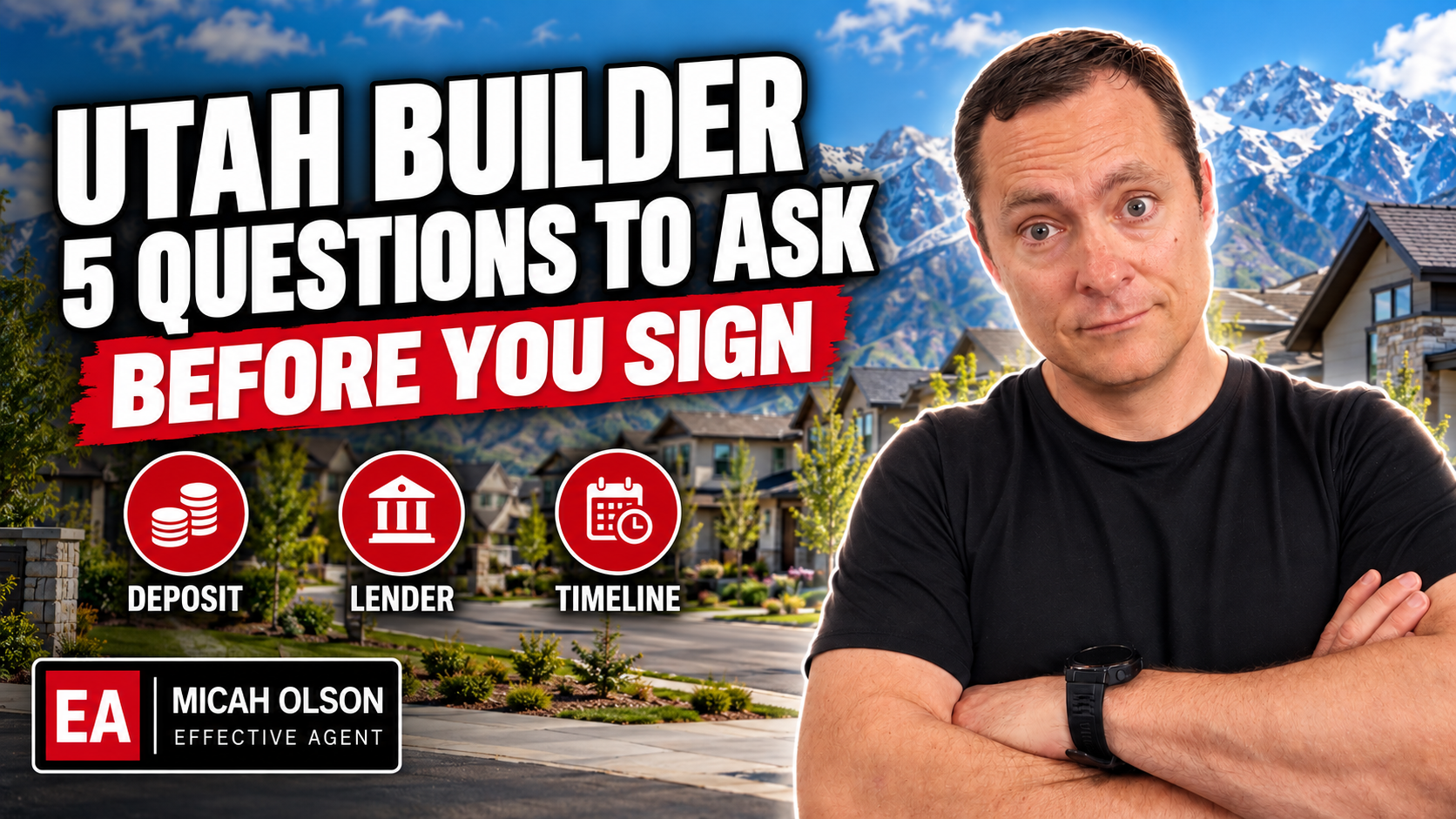
5 Questions That Actually Protect You Buying New Construction in Utah
Quick Answer: The biggest protections for a Utah new construction buyer are free and come from asking, not from hiring a lawyer.…
-

What Happens If Your Utah Builder Misses the Closing Date?
Quick Answer: It rarely happens. Large production builders in Utah, like DR Horton, EDGEhomes, Ivory Homes, and Lennar, are tight on closing…
-

Over Budget on New Construction Upgrades in Utah? Cut These First
Quick Answer: When a Utah new-build upgrade list runs over budget, cut design-center finishes first — flooring, countertops, and paint colors —…
-

Large Lots in Utah New Construction: Why a 1/3-Acre Lot Is Rare
Quick Answer: Large lots in Utah new construction are rare because land near the Silicon Slopes job centers got expensive and builders…
-

The Utah $20,000 Grant and the Builder Rate: Here’s the Catch
Quick Answer: Utah’s $20,000 first-time buyer assistance for new construction only comes through a Utah Housing Corporation first mortgage. Because a Utah…
Ready to Evaluate New Construction Options in Utah?
The new construction market in Utah County and Salt Lake County is active, and the incentive landscape changes regularly. Builders adjust their programs based on inventory levels, interest rates, and sales pace — which means what is being offered today may be different in 60 days.
If you are seriously considering a new construction home in Utah, the best time to start the evaluation is before you walk into a model home — not after. Once you are in the design center chair, decisions feel more urgent than they need to.
There is no pressure and no obligation. If you want a clear, honest read on which builders, communities, and incentive structures are worth your attention right now, that is exactly the kind of conversation this is built for.
Micah Olson — Your Utah New Home Relocation Guide Utah County and Salt Lake County | Licensed since 2001 | 29+ Years of Utah Real Estate Experience